Stemming from ethnographic research in a chronically poor district of rural Uganda, this paper recounts a number of attempts to investigate young people’s understanding of HIV and its transmission. The failure of the initial, more traditional methodologies are used to critically evaluate the positionality or role the researcher played as she became embedded within the community to the extent she lost objectivity as a researcher. Inadvertently, a simple building block game was used as a methodology. This was successful in generating interesting ‘data’ and proved that even research groups deemed difficult to access can be reached with some methodological consideration. The tool was, however, almost over successful and generated dramatic ethical dilemmas which ethically questioned the potential of the research and had a significant impact on the researcher. This paper therefore stresses the necessity to give ethical consideration to the research and its participants but to not over look the researcher.
“I’m not sure, but I think, well I think I might be pregnant, I don’t know what to do…. I can talk to you, in confidence….can’t I?”
This paper stems from my PhD fieldwork which was conducted in Kibaale District, a chronically poor rural district of mid western Uganda. About a year into my research I was approached by a local non-governmental organisation (NGO) and asked to investigate young people’s understanding of HIV and its transmission to help inform a new education programme. What ensued was the use of standard research methods that miserably failed in part due to my strong rapport with the community. This could seem like the naïve response of a weak researcher. Alternatively it could highlight that I had become so embedded within the community it was natural to adopt the local, standard research methods in line with HIV thinking. These were the very methods that had both failed in the past and in my PhD continuation viva less than 12 months previously, I had vehemently criticised. The failure made me question my skills as a researcher in general but specifically my positionality within the community and how that could affect the research. Inadvertently, a simple game became a research methodology. It was far from standard and ironically worked only because I had become so embedded within the community – which was the very reason I thought the research had initially failed. This time, the research tool was almost over successful and I found myself in highly difficult ethical dilemmas. Not only did this affect the appropriateness and validity of the data, but it had a dramatic impact on me personally. Therefore, whilst the specific findings of this research were both interesting and useful to inform new HIV education policy, the focus of this paper is not what was found, but how it was found and the implications that had on the researcher and in turn, the research.
The specific aims are threefold. Firstly drawing on my ethnographic fieldwork this paper critically evaluates the role of the ethnographic researcher and my potentially contradictory aims of becoming embedded within a community whilst remaining an objective researcher. Secondly, this paper will show how the use of an innovative, albeit unintentional, research methodology enabled appropriate access to a sensitive research area and in turn benefitted policy. Thirdly, and potentially most importantly, this paper highlights the necessity to give ethical consideration to the researcher who has an equally important part to play in the research process as the participant and who may, ironically, be exposing themselves to harm through the ‘success’ of their research.
Whilst this article is about the role of the researcher and research methodologies used, it is appropriate to provide a brief overview of the contextual background to the research and particularly my role within it.
Extensive ethnographic literature exists on HIV and AIDS in sub-Saharan Africa focussing on the problems associated with transmission (Campbell, 2003; Setel, 1999) and particularly on the relationship between sexual behaviour and HIV and AIDS (see amongst others, Parker, 2001). As perhaps the most stigmatised medical condition in the world, HIV can be viewed as a disease associated with immorality, punishment and death largely due to its association with illicit or immoral behaviour and deviant practices (Herek 1999; Gilmore and Somerville 1994). As a result, many prevention programs focus on increasing people’s knowledge about sexual transmission, hoping to overcome the misconceptions that may be acting as a disincentive to change towards safer behaviours. Researchers have subsequently identified ‘young people’ aged between 14 and 18 as a vital group for intervention and sexual education (WHO 2008).
I became particularly interested in people’s beliefs and ability to access information about their sexual health with a particular emphasis on HIV through my fieldwork in the hospital, HIV outreach work in the surrounding villages and my general daily life in Kibaale. My PhD research is based in Kibaale district, which is part of the Bunyoro Kingdom, mid western rural Uganda and home to the Munyoro. For two years I lived in Nalweyo sub county and walked to what was locally referred to as ‘the hospital’ (the Health Centre IV, ranked as such in relation to the services that were available) in Kakindo, 8 miles away. My PhD actually investigates the cultures of healthcare practice of nurses within the hospital with a view to improving healthcare delivery to the world’s poorest communities; it does not directly focus on HIV transmission as such. The prevalence of HIV in Uganda however, now ranks highly amongst global figures contributing the average life expectancy of only 50.7 years (World Bank 2008) despite Uganda once being seen as the model of a governmental response to the HIV and AIDS epidemic. An average of 77,000 adults and children are thought to have died from HIV and AIDS in 2007, leaving an estimated 1,200,000 orphans (WHO 2009). There are no reliable recent statistics of the HIV prevalence in Kibaale however personal experience suggests many people had either direct experience of the virus or knew somebody living with HIV. Certainly for the majority of my two years of fieldwork, an extra pair of hands was required, not in Out Patients or the General Medical ward, but in Antenatal (ANC) and Prevention of Mother To Child Transmission (PMTCT) of HIV clinics.
During the time I spent working in the hospital, the rate of underage pregnancy became strikingly apparent. It was a running joke amongst the nurses for example, that when a clearly young woman came to the clinic ‘she was eighteen- like the others’. Reliable, official statistics are, again, unavailable but it was regularly clear that young women presenting at ANC were under the age of 18 which is the legal age of sexual consent. My PhD research was motivated by reports of abuse suffered by patients in hospitals at the hands of healthcare workers, particularly in sub Saharan Africa and some authors have identified a link between ill treatment and underage or HIV positive patients (see Moll 2002). This, in turn can act as a deterrent to patients accessing hospitals services such as PMTCT which has proven both effective and cost efficient (see Coffie et al. 2008) and Voluntary Counselling and Testing for HIV.
A number of researchers have identified that age at first sexual experience is falling (e.g. Rivers and Aggleton 1999). Furthermore, as Gwanzura-Ottemӧller and Kesby, (2005) highlight, research, actually conducted in Uganda (see James-Traore et al. 2004), suggests that children or young people who are well informed are less likely to engage in early sexual activity and more likely to eventually practice safe sex (Jorgenson et al. 1993). The Bunyoro Kingdom is broadly classified as chronically poor with lowest standards of living being in Nalweyo and Kakindo amongst other local sub counties. Subsequently Kibaale has actually received a number of HIV awareness initiatives. In relation to young people there are however two key problems. Firstly, many of these initiatives are based on the ABC policy of abstinence, being faithful and lastly, using condoms. It has to be acknowledged that, perhaps surprisingly, some researchers actually suggest the lack of condom promotion in favour of abstinence in the 1980s and 1990s played a significant role in Uganda’s initial success in tackling the epidemic (Allen and Heald 2004). However, whilst it is difficult to prove without statistics, firsthand experience of at least one case a week of a woman thought to be under the age of 18 presenting at ANC suggests this policy is not working in Bunyoro.
The second problem is one of access. Uganda has a policy of Universal Primary Education (UPE) which entitles every young person to engage in primary education. It is widely known however that the quality of this education varies and is particularly poor in rural areas. There is a generally low opinion of education in Bunyoro so whilst many young people go to school initially, few complete their schooling and many drop out very early favouring subsistence farming or marriage. Subsequently, the most at risk cohort of young people aged between 15 and 18 are largely illiterate so cannot access publications even when printed in their own language. Within this cohort, males in Kibaale are particularly difficult to physically access. They tend to be aloof so, for example, pass time in remote makeshift drinking huts rather than physically engaging with the community and generally spend little time in the trading centre. Both reflective and informative of this, young men aged 15-18 (and older) receive quite a bad press which in turn acts as a barrier to their engagement with the community. A range of literature addresses young people’s use of so called ‘public’ space (e.g. White 1993; Australian Youth Policy and Action Coalition 1992) and how as an often marginalised group they can be reconstructed or misinterpreted thus progressively alienated (see for example Sibley 1992) which in turn prevents their access to health education.
An interesting finding of this research worth noting here, was that many young adults conveyed their distain at being ‘patronised’ by inappropriate health education methods such as drama groups. Drama as a health promotion method has proved to be very successful in some settings (e.g. Soloman et al. 2004 in India; McGill and Joseph 1997 in Sri Lanka). They were often used in Kibaale by local health promoting NGOs to target both schools and adults but later, adults who had watched the performances would often comment on how embarrassed they were, particularly being taught by children whose knowledge they questioned. This was an interesting point. After a particularly impressive drama and singing routine at International HIV and AIDS Day celebrations, 2006, led by clearly well taught children from a local school, I asked the lead singer what HIV stood for and how it could be transmitted. He could not tell me.
After a number of discussions with local teachers and representatives of various NGOs I was asked, as a researcher, to investigate this situation and attempt to access this illusive cohort of young people aged 15 to 18, in effort to gain an insight into their understandings of HIV and its transmission. It was hoped that this information could be used to write sex and health education programmes that were appropriate and accessible to this at risk cohort, in effort to control the transmission of HIV and other sexually transmitted infections and reduce the rate of unplanned pregnancies.
As my personal role as a researcher clearly had such a significant impact on the research it is important to briefly explain my life in the village and the relationships I endeavoured to forge with the community.
To research my PhD I lived in the trading centre of Nalweyo sub-county for eighteen months and walked the 8 miles to the hospital in Kakindo on a daily basis. I was the only resident white person for a two hour drive in any direction so, unsurprisingly, attracted a lot of attention. When I first arrived, as almost the local celebrity I was invited to people’s homes, to parties, to weddings and to church, at which I was of course expected as the white person, to give a sizeable donation to proceedings. From the outset I endeavoured to learn community life. With bemusement, the community watched me struggle at the borehole for water every morning, cook (badly) over charcoal, live by candlelight and, in short, live a local life within the community. Walking to and from the hospital every day, whilst time consuming and a physical effort, meant I could stop and talk to people who quickly got use to me. It is highly naive to say that anybody from such a different background could become entirely part of a community, however soon the high profile invitations to formal weddings and parties were joined by invitations to the local market in Katekara on a Monday, and to do my washing (and gossip!) with the ladies at the weekend. I was shown how to cheat and use a caverra or plastic bag to light the charcoal stove (you save expensive paraffin that way) and how to make a make shift water storage tank to reduce the number of trips to the borehole. I would lament about local politics, the dreadful local police force and speculate about blossoming potential marriages over chai (tea) after work. I would regularly be invited for supper but as part of the family, so I would sit on the floor and eat from plastic dishes with my fingers the way everybody else did rather than being given the china plate and fork saved for special guests. I soon became known either as the ‘mzungu musawo’ (white nurse) or ‘Abwooli’ which was my Munyoro epako or pet name. Whilst there would always be a gulf between our social identities, I felt I had my own little part within the community, I had been accepted despite my differences. In turn, people were highly interested in my research. It was part of one of many discussions, about a year into my PhD research, that I was asked to undertake an investigation into young people’s beliefs about HIV and its transmission.
In a brief moment of personal confession, I am somewhat embarrassed by my sheer ineptitude at undertaking this task. As a well trained researcher I totally understand that ethnographic fieldwork should be intuitive, empathic and reactive (Bakhtin, 1981), and entirely recognise the field as a dialogic space. I understand that ethical considerations should play a vital role in any research but particularly when researching sensitive issues. I genuinely believe that whilst the specific definition of a sensitive issue depends upon context, broader cultural norms and values (McCosker et al. 2001), the presence of any ‘sensitivity’ in research poses potentially difficult implications for its design, the recruitment and interviewing of participants and indeed the resultant validity and reliability of the research (Fenton et al. 2001b; James et al. 1999). I further understand that some topics and the contexts in which they are studied, require the development or use of methodologies that are particularly receptive to sensitivity in research (Elam and Fenton 2003). On the basis of all of this understanding it was highly significant that, a year into living within the community, after lengthy discussions with teachers and NGO workers, I agreed to investigate this research using a basic, traditional and highly inflexible methodology which, as will be described, triumphantly ‘crashed and burned’.
Since 1996, under the Government’s UPE policy, schooling is available to all young people. In preparatory discussions to set up this research, we therefore agreed it would be possible to access young people through school. Whilst this did not represent the exact intended sample of the research, we felt it would be useful to establish some idea of the base level of young peoples’ understanding of HIV and its transmission. Consequently I developed a very simple questionnaire and asked a school master and personal friend, to administer it to his Primary 5, 6 and 7 classes in his school in the next trading centre of Burroko. His classes consisted of young people, in theory aged between 13 and 16 although could often include much older students who maybe started school late, had to repeat a few years or had returned to education. I particularly asked the master to administer the questionnaire as I was concerned that despite the fact I was known within the community, or even because of it, my presence – as a white, western, woman – might prove to be a distracting influence.
My positionality was key throughout the research and my PhD in general. As Bowes and Meehan Domoros (1996) suggest, the social identities of the researcher and how they relate to their subjects should be of primary concern in terms of both the quality of the research and ethical considerations of it. Oakley (1982) for example, gathered that rapport and minimal social distance was more likely to develop when both the researched and the researcher share the same gender, ethnicity or some other identity aspect which allows for identification and empathy between the interviewer and interviewee. In relation, Finch (1981) suggests women researchers work better with women because they share similar experiences. Whilst many of the children would have seen me walking to the hospital and heard about me (news spreads very quickly in the village), because this was a different trading centre, I did not know them personally. My social identity was clearly very different from the subjects in this case and generated a distinct power gulf as I was older, western and educated and in some cases was also different by gender. I had clearly explained to the school master about this piece of research and felt confident he would be able to administer it, drawing upon his existing relations with the young people which hopefully would also counteract the gender difference with his female students.
I asked the master to write the questions on the board and distribute the pens and paper I had provided. In line with ethical considerations of research in sensitive areas, particularly when it concerns young people or children (see Mauthner 1997), I asked him to ensure the young people understood the research and knew that they had the right to withdraw from it, at any point, if they wished. I asked the master to clearly stress that there were no right or wrong answers, that they did not need to write their names on their answer sheets and that he would not read them to generally try and encourage them to write freely.
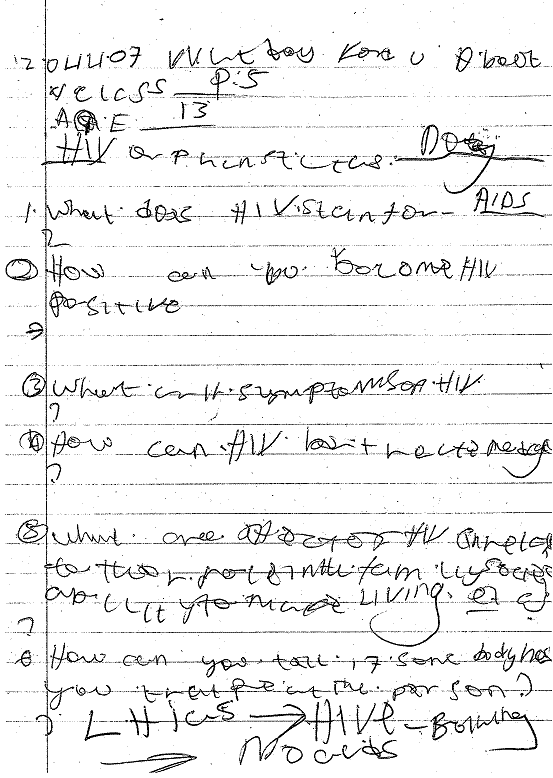
Figure one is an example of some of the responses:
Figure 1: Response 1
This is a fairly representative example, in this case completed by a 13 year old student. The writing is virtually illegible. It is questionable however, whether these answers, or lack thereof, are an indication of the students’ understanding of HIV or their low level of literacy which may have prevented them conveying what they actually knew.
If children in formal education could not complete a simple questionnaire either because they were unable to express themselves generally or in written form, this was clearly not a model that could be replicated elsewhere. I furthermore had made a huge error in asking the master to administer the questionnaire. Clearly the benefit of the rapport he had with his students was outweighed by the respect they had for his authority which would have prevented them from speaking freely. This was further confirmed when some of the young people’s responses were found with spelling corrections from the master and he kindly provided an attendance list. Whilst this highlights his kind wish for the research to prove fruitful, it also shows a clear further limitation in this methodology. With hindsight it probably would have been much more successful if I had administered the questionnaire and actually utilised the distance I had between the participants. As an objective researcher, I should have known this.
The first attempt had failed, my confidence was slightly dented but clearly a new approach was required. Whilst it might seem an unusual methodological choice for eliciting information about private behaviours (see Wellings et al. 2000), many researchers investigating sensitive issues have utilised focus group methodologies. Kitzinger (1990) for example, successfully used focus groups to study the role of the media in audience understandings of ‘African AIDS’ (Britten et al. 1995). Focus groups can create milieus in which social relations are forged and discussions can be initiated which are similar to those experienced in everyday settings (Graham 1983). Often a group dynamic enables the research to establish whether there is a consensus view and to gently direct the conversation on the basis of reactions and interpretations, especially if discussing sensitive or contentious issues. It is important to note however, that the view gleaned is a general consensus rather than an indication of individual behaviour.
Focus groups have however proven particularly effective when one on one interviews are difficult, for example if there is a significant social distance between the researcher and the researched. After the first methodological failure however I was hesitant. There was certainly a social distance between myself and the participants, but I had worked hard to be accepted amongst the community specifically to minimise that. Whilst I did not know these people personally, I was known to them as was my role within the community which I was concerned might prevent people from speaking freely for fear of information about them being spread. Rhodes (1994) and Bowes and Meehan Domoros (1996) argue however that researchers can become too preoccupied with matching researcher and researched thus run the risk of marginalising certain types of research, making, for example, racism only a concern for racialised groups. Furthermore, along with Gelsthorpe (1993), Bowes and Meehan Domoros (1996), suggest there is not an ‘ideal’ position to which researchers can aspire; they have to maintain a reflexive, critical evaluation of those circumstances and the way they influence their work.
So, on that basis I invited young people aged 15-18 to join focus groups to share their views on HIV and its transmission which would be held at local community centres two week from the invitation. Adverts written in the vernacular were placed in prominent places in the trading centres during market days, at the drinking spots, taxi queues and the barbers. To overcome possible literacy issues, drawing on personal networks the word was also spread amongst the market traders; many stall holders actually were young men and women aged 15-18 anyway. Messages were also read out at local churches after the main services on a Sunday which were repeated frequently as the date drew nearer. Sadly my research budget would not stretch to a radio announcement. Not a single participant came to the focus group.
But then, why should they? No tangible incentive had been offered and young people were technically being asked to donate their spare time to divulge behaviour that could be perceived discreditable or deviant. Technically, respondents were being asked to suggest they were not living up to social norms and openly discuss very private behaviour. It was quite possible that young people might have felt threatened or vulnerable by the very social distance between a white, western, female researcher and themselves that I hoped would make the focus groups work. They may have been concerned about divulging information in front of their peers in a focus group setting. They may have just not been interested. I wondered whether it may have proved fruitful to capitalise on the difference in social identity and invite participants for a personal interview with a stranger who would then make their responses anonymous. I also wondered however whether I was no longer enough of a stranger within the community to make this work, ironically a status I had worked incredibly hard to achieve.
I was more than a little despondent and spent far too long agonising whether I was actually capable of researching for a PhD – no doubt a feeling familiar to many. That weekend I had to travel to Uganda’s capital Kampala. In a shop selling highly overpriced exports I stumbled across “Jenga” the simple wooden building block game which, after some negotiating, I purchased thinking it might provide some evening entertainment for my neighbours. The very first evening in the village, Jenga frenzy hit. With simple pieces of wood, no batteries, bright colours or flashing lights, the game was intriguing yet unintimidating. People were amazed and over a couple of nights a growing crowd of neighbours, largely grown adults and their children, gathered to watch or play. Within the week we had to retreat to the community hall to physically accommodate the numbers of people interested in playing or watching the game. Very quickly, in part due to the sheer volume of people and only having one physical game, tournaments developed with each player paying a token of 200 Ugandan shillings (approximately 6 UK pence; locally a small bottle of mineral water costs 500 Ugandan shillings) which became prize money. Within a few weeks inter-trading centre tournaments were arranged with the Munyoro trading centre of Nalweyo playing their Mkaiga counter parts at Katekara (see photograph 1). There is a historical legacy of, at times, violent strife between the indigenous Munyoro in Nalweyo and the resettled Mkaiga in Katekara. In Swahili “jenga” means “build”. More than one village leader commented on the building of relations over troubled soil.
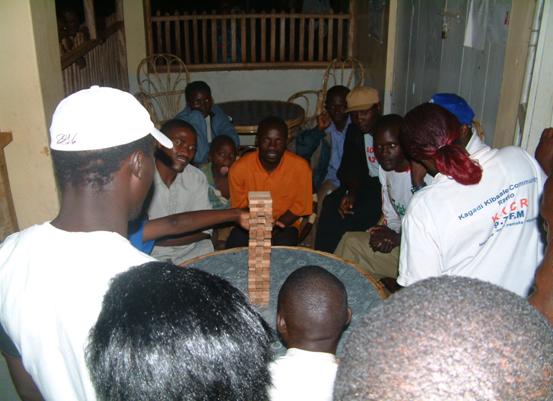
Photograph 1: “Jenga frenzy”
There was perhaps a slight irony that grown adults would be so captivated by such a simple game but it brought joy and commonality to the villages. Swiftly after introducing the game it was not uncommon for people to come to my hut and knock on the door in the evening to ask to play Jenga.
On one occasion however I had been working nights so was home and was surprised when there was a knock on my door during the day. Standing there was a group of six young men aged between 13 and approximately 17 who had heard rumours about the Jenga phenomenon. It was midday when most people rested to keep cool and these young people had finished their work on the fields and were bored and curious. To be clear, at this point there was no reference made whatsoever to the research. Bearing the later ethical dilemmas in mind, it actually may have been easier in the long term to expressively use Jenga as a research methodology but at this point the two were completely unrelated. I gave them the game and taught them to play.
It was really significant that the young men were willing to approach me. I had endeavoured to become part of the community as far as possible which, as a young woman, meant I naturally spent more time with other women. I did however work hard and lived amongst the community for an extended period of time and did not, for example, commute from a bigger town. Many people spoke of me as their ‘friend’ and how I was ‘helping’ the community particularly at the hospital and I had my epako which was a great honour; news of this would have spread. It could however very easily be argued that the young people stood at my door were there only because they wanted to play the game and motivated by that desire found me approachable enough. Either way, it initiated and enabled discussion.
Whilst much literature recognises the direct role of learning games in education (see for example Gee 2003), in this case the game was (inadvertently) used to help bring down some barriers and build understanding which enabled me to actively utilise my positionality. Puwar (1997) makes the point, which could be extended further than feminists and ethnographers, that chatting is important for creating rapport and for gaining an insight. Building on their prior knowledge of me, by playing the game I was able to create such a rapport and gain a general insight into these young people’s lives. After ten days young women also came to play. They did not stay as long as their male counterparts as they often had to leave to check on food that was cooking or finish washing clothes. Many brought small children they were minding or food to share amongst the group and particularly for me. The slight difficulty was the young people were reluctant to play in the evenings when the trading centre was busier so I had to either hurry back from work or stay awake and play the game having worked a night shift. Through playing Jenga however we developed a rapport to the point of friendship. The young people asked endless questions about the UK, my family and what I thought of Bunyoro and Uganda in general. They looked at my photographs, we shared stories and they laughed at my poor washing skills. About two weeks later one of the young people asked me about the invitation to ‘some gathering’ that he knew I had been involved in.
This was the first ethical dilemma. Arguably the beauty of a piece of research is that issues (sensitive or otherwise) arise through the developing reciprocal relationship between researcher and research subject that cannot be anticipated or pre-prepared for. I was not prepared for this, it was not my intention to use Jenga as a methodological tool but the potential to glean useful information became immediately clear. It was also clear however that if I spoke about data collection for an NGO it was unlikely the young people would be forthcoming with their ideas but equally it was unethical to deceive. The Association of Social Anthropologists, ( 2005) suggest that despite thorough ethical consideration, social researchers are increasingly faced with competing duties, obligations and conflicts of interest particularly in the field, which force them to make implicit or explicit choices between the interests of different individuals and groups. It could be argued then that the success of research lies predominately in the researcher’s skill and ability to adapt to a situation. So I ‘came clean’ and explained what the reasoning behind my interest. The young people listened, acknowledged, finished their game and left.
The next day there was a knock at the door and a group of approximately twelve grinning young people asked to play Jenga. We walked over to the community centre and played. As it came time to leave a more confident, male member of the group fell behind the others and helped me to collect the Jenga pieces. He thanked me for letting them play Jenga and told me he thought of me as a friend. He then asked questions that made it clear that the failed focus group and its purpose had been discussed amongst the ‘Jenga group’. He wanted to know why I was collecting this information, how it would be used and whether the data could be traced back to the informants. I answered his questions and particularly gave him my assurance that the upmost ethical guidelines would be followed, all data would be coded therefore anonymous and totally untraceable. He asked me in turn whether I might be able to help them. With ethics as my highest priority I was keen not to make false or misleading promises. I said I could provide information and advice but could not provide any tangible help. He pondered this for a moment before saying farewell.
The next day there was a knock on my door and two young women who had been coming to play for a number of weeks asked to play Jenga. As good friends and true gossips, we usually made vibrant small talk so I was acutely aware of the awkward silence as we walked over to the community hall. Eventually one of the young women started whispering to the other and nudging her until she began to nervously ask me some questions. She explained she had been with her partner for a few months and was concerned that she might be pregnant although she was unsure they had actually had sex. She was 14 and her partner 17. She explained she had already contemplated going to see a herbalist to buy herbs in case she proved to be pregnant but she was frightened because another woman from her village had recently died by taking herbs to abort a pregnancy. She said she trusted me as her friend and knew I was a nurse who worked at the hospital and could therefore give her some tangible advice about what she could do. She asked me whether she could talk to me in confidence. By this point we had reached the community hall and had set up Jenga. The young woman explained she could not approach anybody actually at the hospital, even me, because she was underage. She was worried she might be treated badly and that word would spread resulting in her being ostracised from the village with a baby she could not care for and that the father might leave her. She was particularly concerned she might be forced to take an HIV test.
Suddenly it was my turn to play and the welcome pause gave me a moment to think; I found myself turning the smooth piece over in my hand and staring at the dust swirling in a shaft of light projected from the doorway. Abortion in Uganda is illegal and herbs can be very dangerous. It suddenly hit me just how little comfort I could actually offer. The young woman stared blindly at the wooden tower, her shoulders sagging in defeat. I explained about various NGOs in the area that were offering programmes that might support her. I also suggested it might worth paying a few thousand shillings to buy a pregnancy test at a local private clinic to at least find out for definite whether or not she was pregnant. She nodded despondently. We finished the game in excruciating silence. Nobody suggested we play again.
The sense of personal and professional failure was overwhelming. It was too late to offer any tangible advice to have prevented the situation and there was little I could suggest now to help, except to advise her not to put herself into the dangerous position of going to see a herbalist. If she had come to the hospital we could have conducted a pregnancy test to find out whether or not she was actually pregnant – at least I could have done something to help but she would not go to the hospital and I was ethically bound to not betray her confidence. I know she had hoped I would give her information that would ‘fix’ the situation and she clearly felt her gamble in trusting somebody that she was pregnant to gain help, had not paid off. Furthermore, whilst the very necessity of this research had been proven by her explaining she thought she could be pregnant yet was not sure if she had had sex, it would be unethical, as her “friend”, to use this information in the research report. We were not in a research setting; she was not informed about the research but had instead engaged me in conversation about her difficult circumstances. As Farmer suggests, ‘research is often a very inappropriate response to suffering’ and that ‘in such instances we may find that personal integrity and professional interests are best served by putting aside tape recorders and notebooks’ (1992: 315). I did not report this information to the NGO.
The next day the Jenga group came back to play; the young woman and her friend were not with them. Enquiring about their whereabouts I was told they had to work in the fields. I realised instantly that I was in a very ambiguous position and needed to address this situation. I explained to the group frankly that I was interested in their understandings about sex and particularly HIV transmission and that I could share some useful information with them. I explained again how the data would be anonymous and that they had full right to withdraw from the discussions at any point but also that I would like another researcher whom I trusted to be present. They agreed and quickly enough to suggest they had previously discussed the possibility of sharing such information. The following day we held a very successful focus group with a female, Munyoro, representative of the NGO which was repeated with friends of the group a number of times to gather sufficient information on which to base a report to develop an educational programme.
Over the next few weeks I enquired repeatedly after the young woman. I wrestled with my conscious continuously about whether there was more I could have done. Strangely I found this far more difficult to cope with than any of the often much more extreme situations I encountered in the hospital, largely because at least in the hospital I could be satisfied that we had done all we could within the resource constraints to help a patient. I had the prevailing feeling I should have done more to help her and that I had not prepared myself fully for the potential outcomes of this research.
I saw the young woman again, by chance, three months later. She clearly was not pregnant.
I learnt a great deal from this experience and it went on to affect the remaining year of my PhD research. I certainly learnt that it is possible to access even illusive groups of people with some creative thinking and to research sensitive issues to ultimately gather information that may be beneficial in the long term.
I was proud that within only a year I had generated sufficient rapport within the local community for people to approach and trust me enough to undertake this research. I was amazed however by how, after only a year, I seemingly ‘forgot’ all my research training, lost critical insight and after 12 months of trying to live like a Munyoro, I adopted the same local research methods that had previously failed. Within the first methodological ‘take’ there were logistical problems with administering a written questionnaire. Greater than this though, I misguidedly believed the master was in a better position to administer the questionnaire because he was known to the school students and they respected his authority. In this case his authority was too great and the difference in social identity between me and the students actually would have provided a more neutral arena for them to speak freely. Take two, the focus groups, failed to materialise which may have been because I was too embedded and too well known within the community but not to the research participants personally who may have feared I could not be trusted. Furthermore, if I had remained objective, I would have considered this.
As mentioned earlier, Gelsthorpe (1993), Bowes and Meehan Domoros (1996), suggest there is not an ‘ideal’ position to which researchers can aspire; they have to maintain a reflexive, critical evaluation of those circumstances and the way they influence their work. I lost the level of critical evaluation. I was over complacent about my role within the community and failed to consider how it would affect the different research methods. I have never overlooked this since. It is however, highly ironic that the successful method worked only because I had a strong rapport with the community. An interested was supported by the clear trust the community had in me which encouraged young people to come and play Jenga. In turn I was able to develop a rapport that built understanding and enabled conversation.
The success however was almost too great and I found myself in a difficult ethical dilemma as the conversations began to generate information that ultimately would be very useful for the research, but could not be used due to the nature in which the data was collected. In all the ethical considerations I have given to research in the past I have never contemplated how it could impact me as a researcher. In this case, the vigour with which I threw myself into my PhD research, and into later focus groups with the NGO researcher, lay testimony to my necessity to do something to mitigate the emotional impact of feeling I had failed the young woman who asked for help because she thought she was pregnant. To some extent this was inevitable due to the context of the research and had I extended my ethical consideration beyond my research participants I might have recognised the potentially difficult situation. From this experience what became most clear was the necessity to ethically protect the research and the participants involved, but also myself as the researcher.
Allen, T., and Heald, S. 2004. HIV/AIDS Policy in Africa: What has worked in Uganda and what has failed in Botswana. Journal of International Development 16:1141-1154.
Association of Social Anthropologists of the UK and the Commonwealth. 2005. Ethical Guidelines for Good Research Practice.
Bowes, A.M. and Meeham Domokos, T. 1996. Pakistani women and maternity care. Raising muted voices. Sociology of Health and Illness 8(1):45-67.
Brannen, J. 1988. The study of sensitive subjects. Sociological Review, 36: 552-563.
Britten, N., Jones, R., Murphy, E., Stacy, R. 1995. Qualitative research methods in general practice and primary care. Family Practice 12 (1):104-114.
Campbell, C. 2003. ‘Letting them die’: Why HIV/AIDS Prevention Programmes Fail. Oxford, Bloomington & Indianapolis and Cape Town, International African Institute.
Coffie, P.A., Ekouevi, D.K., Chaix, M-L., Tonwe-Gold, Clairsse, A-B., Becquet, R., Viho, I., N’dri-Yoman, T., Leroy, V., Abrahams, E.J., Rouzioux, C., and Dabis, F. 2008. Maternal 12-Month Response to Antiretroviral Therapy following Prevention of Mother-to-Child Transmission of HIV Type 1, Ivory Coast, 2003-2006. Clinical Infectious Diseases 46(15):611:621.
Elam, G., and Fenton, K.A. 2003. Researching Sensitive Issues and Ethnicity: Lessons from Sexual Health. Ethnicity and Health 8(1):15-27.
Finch, J. 1984. ‘It’s great to have someone to talk to’: the ethics and politics of interviewing women. In Bell, C. and Roberts, H. (eds) Social Researching: Politics, Problems and Practice. London: Routledge and Kegan Paul.
Gee, P. 2003. What video games have to teach us about learning and literacy. Computers in Entertainment 1(1):20.
Gelsthorpe, L. 1993. Approaching the topic of racism: transferable research strategies? In Cook, D. and Hudson, B. (eds) Racism and Criminology. London: Sage.
Graham, H. 1983. ‘Do her answers fit his questions?’ Women and the survey method. In E. Gamarnikow, D. Morgan, J. Purvis and D. Taylorson (eds) The Public and the Private. London: Heinemann.
Gwanzura-Ottemӧller, F. P., and Kesby, M.G. 2005. ‘Let’s Talk About Sex, Baby…’: Conversing with Zimbabwean Children about HIV/AIDS. Children’s Geographies 3(2):201-218.
James-Traore, T.A., Finger, W., Daileader Rutland, C. and Savariaud, S. 2004. Teacher training: Essential for school-based reproductive health and HIV/AIDS education. Focus on sub-Saharan Africa. Youth Issues 3:1-32.
James, N.J., Bignell, C.J., and Gillies, P.A. 1999. The reliability of self reported sexual behaviour. AIDS 5:333-36.
Kesby, M. 2000. Participatory diagramming as a means to improve communication about sex in rural Zimbabwe: a pilot study. Social Science and Medicine, 50(12):1723-1741.
Kitzinger, J. 1990. Audience understandings of AIDS media messages: a discussion of methods. Social Health and Illness 12:319-335.
Lee, R.M. 1993. Doing Research on Sensitive Topics. London: Sage.
Lee, R.M., and Renzetti, C.M.. (eds). 1993. Researching Sensitive Topics. Thousand Oaks, CA: Sage.
Mauthner, M. 1997. Methodological Aspects of Collecting Data from Children: Lessons from Three Research Projects. Children and Society 11:16-28.
McCosker, H., Barnard, A., Gerber, R. 2001. Undertaking Sensitive Research: Issues and Strategies for Meeting the Safety Needs of all Participants. [on-line]. Forum: Qualitative Social Research 2 (1). Available at: http://www.qualitative-research.net/fqs/ (accessed 21 August 2008).
McEwan, R.T, Bhopal, R., Patton, W. 1991. Drama on HIV and Aids: an evaluation of theatre-in-education programme. Health Education Journal 50(4):155-160.
Moll, K.M. 2002. Giving Birth in Kilimanjaro. Germany: University of Bergan.
Oakley, A. 1982. Interviewing Women: A Contradiction in terms. In H. Roberts (ed) Doing Feminist Research. London: Routledge.
Parker, R. 2001. Sexuality, Culture and Power in HIV/AIDS research. Annual Review of Anthropology 30(1):163-179 World Health Organisation (2004).
Puwar, N. 1997. Reflections on Interviewing Women MPs. [on-line]. Sociological
Research Online 2(1). Available at: http://www.socresonline.org.uk/socresonline/2/1/4.html).
Rivers, K., and Aggleton, P. 1999. Adolescent sexuality, gender and the HIV epidemic. [on-line]. United Nations Development programme. Available at: http://www.undp.org/hiv/publications/gender/adolesence.htm (accessed 09 June 2005).
Rhodes, P.J. 1994. Race-of-interviewer effects: a brief comment. Sociology 28(2):547-558.
Setel, P.W. 1999. A Plague of Paradoxes: AIDS, Culture and Demography in Northern Tanzania. Chicago and London: University of Chicago Press.
Skinner, J. 1998. Research as a counselling activity?: a discussion of some uses of counselling within the context of research on sensitive issues. Journal of Guidance and Counselling 26(4):533-540.
Wellings, K., Branigan, P., and Mitchell, K. 2000. Discomfort, discord and discontinuity as data: using focus groups to research sensitive topics. Culture, Health and Sexuality 2(3):255-266.
World Bank. 2009. Country Brief: Uganda [on line]. Available at: http://web.worldbank.org/WBSITE/EXTERNAL/COUNTRIES/AFRICAEXT/UGANDAEXTN/0,,menuPK:374947~pagePK:141132~piPK:141107~theSitePK:374864,00.html (accessed 04 October, 2009).
World Health Organisation. 2009. Towards Universal Access. [on-line]. Available at: http://www.who.int/hiv/pub/2009progressreport/en/index.html (accessed 04 October 2009).
Jennifer O’Brien is a PhD student at the School of Environment and Development, the University of Manchester. Working predominately in rural Uganda her interests lie in health systems’ delivery of appropriate pro-poor care, particularly child maternal healthcare, embedded in a context necessitating a local understanding of notions of health, care, illness and wellbeing.